
For years, enterprise network strategies have focused primarily on capacity. When applications needed to process more data or support more users, the standard response was to buy more bandwidth.
That is no longer enough.
As businesses adopt artificial intelligence, distribute applications across multiple clouds and depend on real-time digital services, network performance is increasingly shaped not only by available capacity, but by the route the data takes.
Two connections can offer the same bandwidth on paper but produce very different outcomes. One may travel directly between an enterprise and its cloud environment. Another may cross more network nodes, physical corridors or national borders. These differences affect latency, resilience, security, regulatory requirements and the customer experience.
At Colt, as we work with customers with vastly varying needs, we have realised that giving enterprises a say in how they want to define their routing has become increasingly important. Businesses need greater visibility into their network paths and more control over choosing routes that support specific operational priorities.
Resilience depends on what lies underneath
The routing issue is particularly significant in Asia, where enterprises routinely move data between markets, data centres and cloud regions separated by large distances. International connectivity is also heavily dependent on subsea cables.
If a cable is damaged or a corridor becomes congested, traffic can usually be redirected. However, the alternative path may be longer or already carrying additional demand. A service can remain technically available while users experience higher or less predictable latency.
For email, a slight delay may be barely noticeable. For real-time AI inference, financial trading, automated manufacturing, remote healthcare or a live broadcast, performance deterioration can become an operational and financial risk.
This also exposes a weakness in how network resilience is sometimes assessed. An organisation may have two connections and assume it has removed a single point of failure. But if both connections eventually cross the same physical corridor, cable landing station or network infrastructure, that diversity may exist only on paper.
True resilience requires an understanding of the underlying routes. Organisations need to know whether backup paths are genuinely separate, where their data will be redirected during disruption and what the effect will be on application performance.
The route is now a business decision
Historically, routing was treated as a technical function managed almost entirely by the network provider. Customers bought connectivity and assessed it according to capacity, availability and service levels. The path underneath the connection was largely invisible.
Today, that path can directly influence whether the business achieves its objectives.
An enterprise running latency-sensitive applications may want the most direct and predictable route. A broadcaster preparing for a major live event may prioritise physical route diversity. A regulated organisation may require traffic to remain within a particular geography. Another business may want to consider the carbon impact associated with different routing choices.
These needs can also change quickly. The optimal route during normal operations may not be appropriate during a major event, sudden increase in demand or infrastructure disruption. Yet changing enterprise connectivity can still require manual orders, multiple technical teams and lengthy provisioning processes.
Businesses can activate computing and storage resources from a cloud platform in minutes. They should increasingly expect comparable visibility and control from the networks connecting those resources.
Making Customer Defined Routing part of the network toolkit
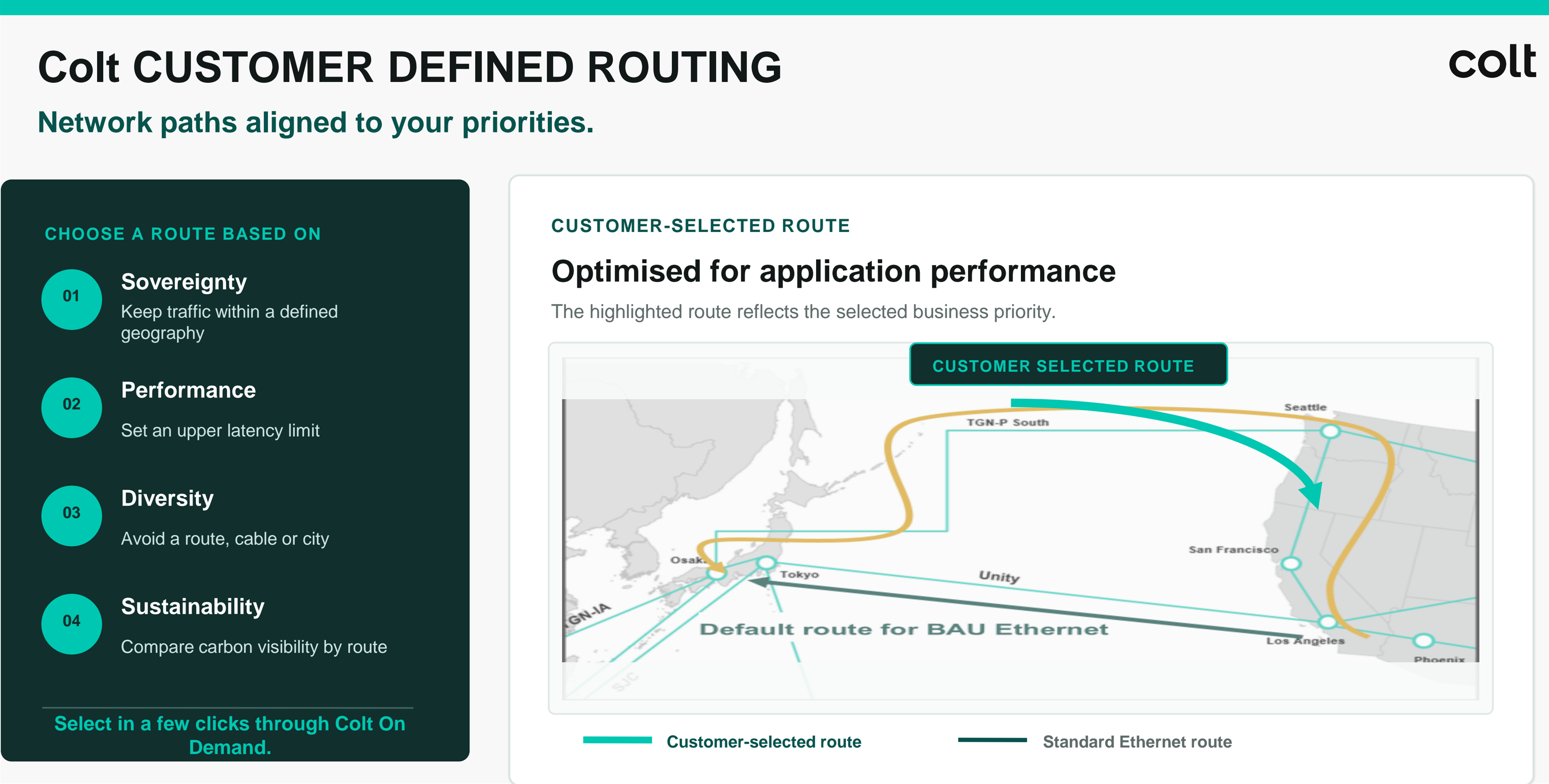
Colt’s Customer Defined Routing capability, previously known as Smart Path, has been developed in response to this requirement.
Delivered through Colt’s Network as a Service platform, the capability is designed to let customers review and select network routes according to priorities such as latency, geographic path and route diversity. Instead of routing remaining an invisible, fixed decision, it becomes something the enterprise can align more closely with the needs of a particular workload.
For example, a business could select a lower-latency route for a performance-sensitive application, choose a specific subsea path to strengthen resilience, or keep traffic within a defined country or region where required. Colt has also explored giving customers visibility into the incremental network carbon emissions associated with individual routing options. The original proof of concept tested how these choices could be made in near-real time rather than through conventional manual ordering.
Customer-defined routing is not a substitute for sound network architecture. Businesses still need adequate capacity, diverse access connections, robust security controls and tested recovery plans. Nor should organisations assume that the geographically shortest route will always be the most resilient or sustainable.
Its value lies in making those trade-offs more visible and actionable. It allows connectivity to be managed according to what the business is trying to achieve, rather than as a fixed utility that changes only when something goes wrong.
As AI and cloud workloads become more distributed, network teams will need to answer a more sophisticated question than “Do we have enough bandwidth?” They will also need to ask where their data is travelling, what risks it encounters along the way and whether that path remains appropriate as conditions change.
The next generation of enterprise networking will not simply connect more locations at higher speeds. It will give organisations greater understanding and control of the journey between them.
Aloysius Ong is the Engineering Head of Colt Technology Services, Singapore.


