
Across Southeast Asia, the enterprise AI conversation is shifting from experimentation to execution. The question is no longer whether large language models (LLMs) and AI agents can deliver value, but how to turn promising pilots into reliable, production-ready systems.
As organisations continue to modernise using AI, one challenge stands out: AI needs accurate, relevant business information that can be integrated into everyday operations. For document-intensive businesses, much of this knowledge remains embedded in contracts, invoices, financial records and trade documents. They are often unstructured and in varying formats, making it difficult to extract and use effectively at scale.
This is where document intelligence can play a foundational role. TextIn, the enterprise text intelligence platform from INTSIG, the company behind CamScanner addresses these needs through two capabilities: xParse, which transforms complex documents into AI-ready data, and DocFlow, which connects document processing with business workflows.
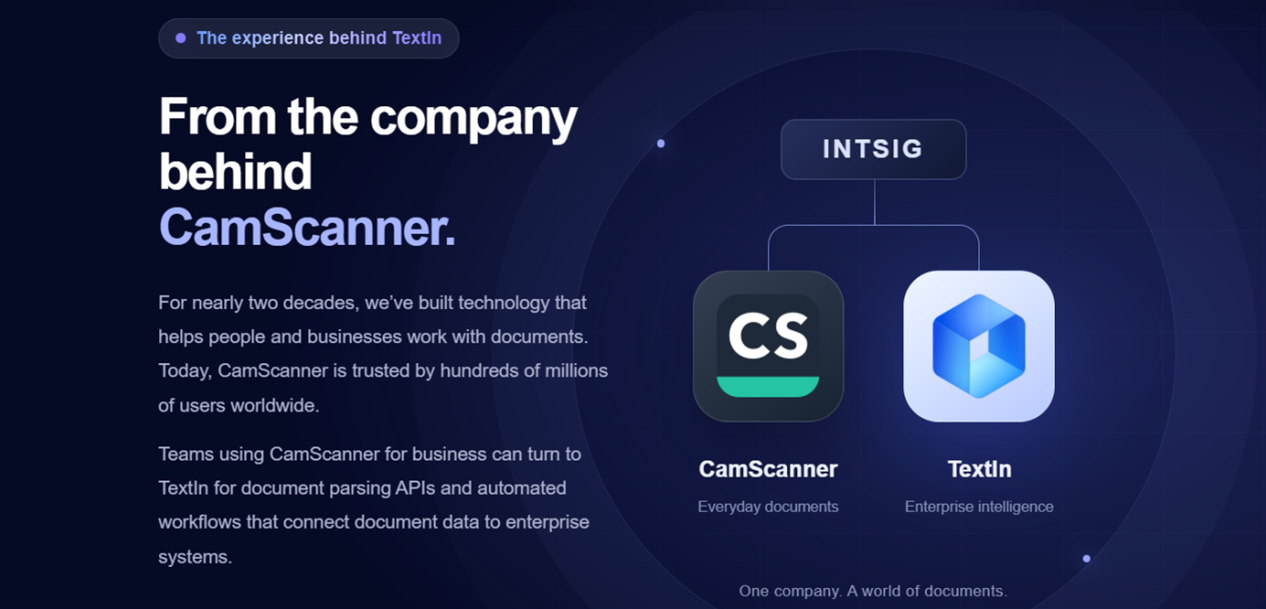
For over two decades, INTSIG has built technology that helps people and businesses work with documents. CamScanner is trusted by more than 300 million users across over 200 countries and regions, and teams using CamScanner for business can turn to TextIn for document parsing and automated workflows that connect document data to enterprise systems.
As of 2025, the company has already served more than 4,000 enterprise customers, including over 170 Fortune Global 500 companies, and held 139 patents globally. Its customer base spans industries and markets, including Geely Digital Technology, iFLYTEK, Linde, Haitian Plastics Machinery, Webasto, CITIC Securities and Macau University of Science and Technology.
Sovereign AI starts with control of enterprise knowledge
As organisations explore sovereign AI strategies, control over data, infrastructure and AI capabilities is becoming increasingly important. For enterprises, this does not necessarily mean building a foundation model from scratch. Instead, it means retaining control over proprietary information and determining where, how and by whom that information is processed and used.
General-purpose LLMs offer powerful capabilities, but they do not automatically understand an organisation’s supplier contracts, underwriting guidelines, customs declarations or internal procedures. Much of this institutional knowledge often resides in unstructured documents, where relationships between fields, tables and supporting evidence can be difficult to preserve.
Turning these documents into reliable, structured data is therefore a critical step towards enterprise AI. Without sufficient context, even a capable model may overlook critical details, misinterpret relationships or produce outputs that are difficult to verify.
TextIn’s xParse addresses this challenge by going beyond conventional optical character recognition (OCR). Using multimodal AI, it interprets complex document layouts, reconstructs reading order, structures tables and charts, and preserves document hierarchies and element-level coordinates that link extracted information to its source.
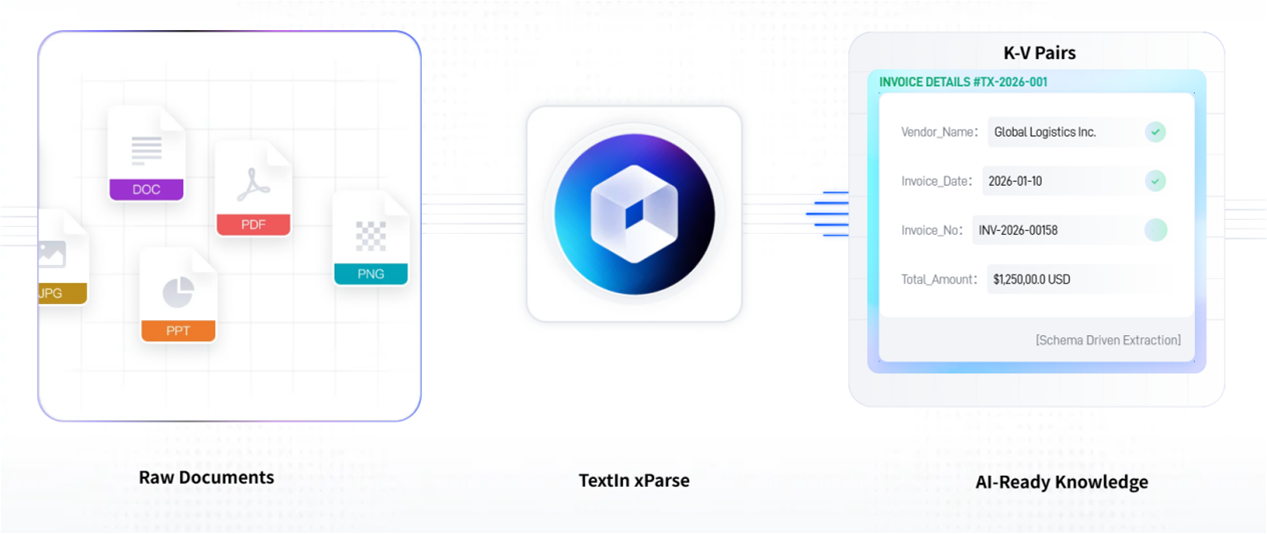
The xParse Document Infrastructure
The resulting outputs, available in machine-readable Markdown or JSON, can provide structured inputs for LLMs, retrieval-augmented generation (RAG) pipelines and downstream AI-agent workflows. By preserving both content and structural context, xParse helps make enterprise information more accessible to AI systems while supporting the verification of extracted information against original documents.
According to TextIn’s internal benchmarks, xParse achieves more than 95 percent overall parsing fidelity on complex documents, approximately 99.7 percent text recognition and over 99 percent table recognition. It supports more than 50 languages and can process up to 100 pages in approximately 1.5 seconds based on performance figures. Actual results may vary, depending on document type and testing condition.
From trusted data to governed business processes
Reliable enterprise data is a starting point, not an end in itself. As AI moves from generating responses to supporting decisions and initiating actions, organisations must consider how information is accessed, how outputs are validated and where human oversight is required.
These considerations are particularly relevant across Southeast Asia, where businesses must navigate diverse regulatory environments. The ASEAN Guide on AI Governance and Ethics provides regional guidance for responsible AI adoption. Meanwhile, Singapore’s Personal Data Protection Act (PDPA) governs the collection, use and disclosure of personal data by organisations within its scope.
Linking extracted information to precise locations in source documents helps teams verify evidence, investigate exceptions and review AI-generated outputs, supporting greater traceability and accountability. The next step is connecting trusted information to operational systems.
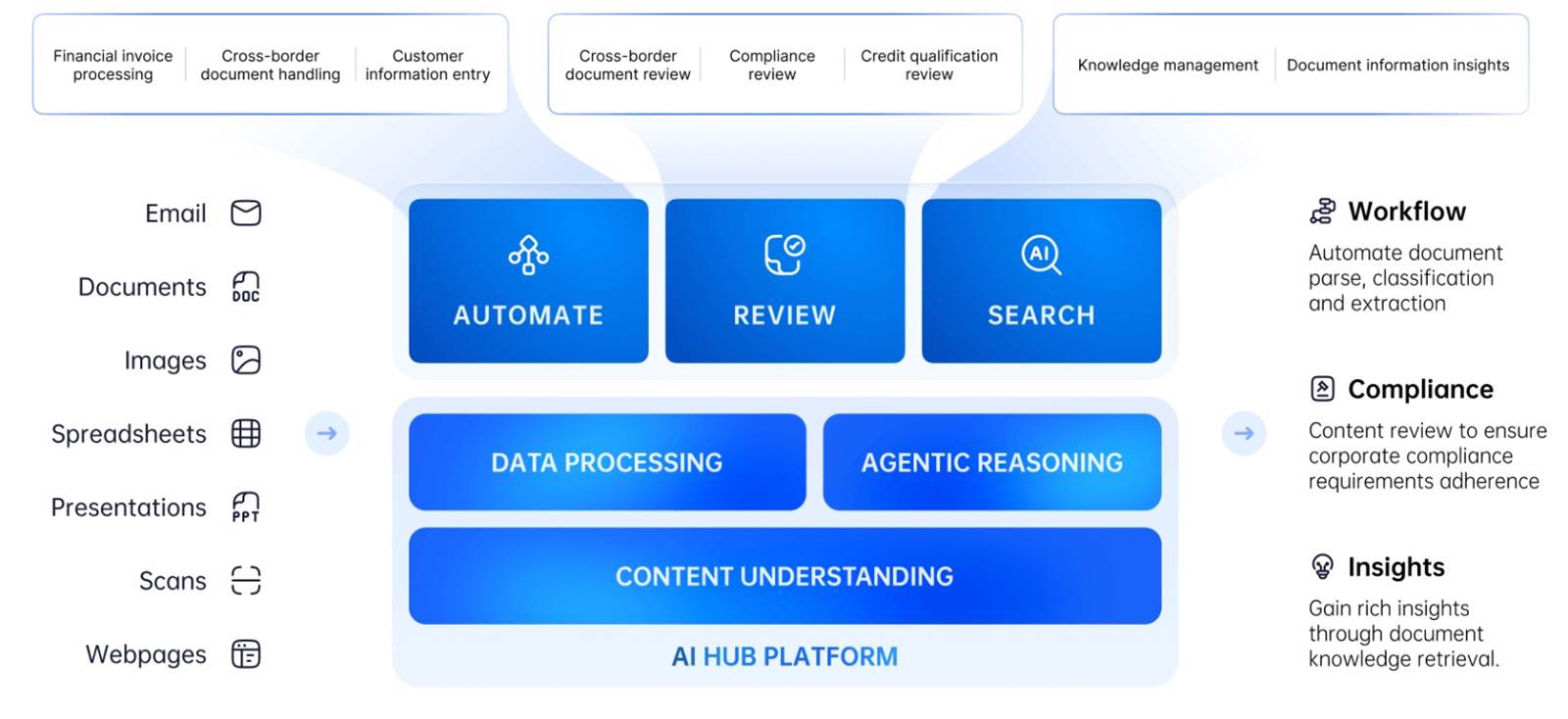
The DocFlow End-to-End Document Processing Agent
TextIn’s DocFlow supports end-to-end document processing, from multi-channel ingestion and classification to document splitting, information extraction, intelligent review and validation. It then routes system-ready information into enterprise platforms such as ERP and CRM systems.
For finance, trade, logistics and compliance teams, this can reduce manual hand-offs and create a more consistent path from incoming documents to downstream processing. For organisations developing AI-agent applications, combining structured information with appropriate safeguards and workflow integration also creates a more controlled pathway from AI-generated outputs to business actions.
Turning enterprise AI into measurable business value
The value of this quick and intelligent processing becomes clearer in document-intensive industries, where the quality and timeliness of information directly affect operational performance.
Cross-border trade is one example. Transactions can involve multiple document types, complex data relationships and time-sensitive clearance processes. Inconsistent information, manual verification and processing delays can increase operational costs and slow the movement of goods.
Automating parts of this process requires more than recognising text: information must be extracted, checked and delivered to the systems that support subsequent decisions and actions.
In a global logistics customer case of TextIn, the customer reported up to 75 percent less manual effort, approximately 90 percent data accuracy and around 30 percent faster clearance. While results vary by workflow and operating conditions, these reported outcomes illustrate the potential benefits of connecting document intelligence with operational processes, allowing employees to focus more on exceptions that require attention.
Security and deployment choices are equally important when organisations handle commercially sensitive or personal information. TextIn offers private deployment options alongside cloud delivery, while INTSIG holds certifications including ISO/IEC 27001, ISO/IEC 27701 and ISO/IEC 20000. Enterprises should assess these options against their security, data governance and regulatory requirements.
As AI adoption matures across Southeast Asia, enterprises will need more than capable models to achieve reliable results. They must make business knowledge accessible, establish appropriate controls and connect AI outputs to operational processes. The document intelligence heritage behind CamScanner—over 20 years of experience and more than 300 million users worldwide—now underpins TextIn’s enterprise platform.
Through xParse and DocFlow, TextIn helps organisations build these foundations, turning existing enterprise information into a practical resource for AI-enabled operations.


